Slow jogging app for iPhone
The 180 rhythm, in your pocket.
Niko Niko helps you run gently and regularly - at a pace where you can still chat, with a smile. What counts is time and rhythm, not speed or distance.
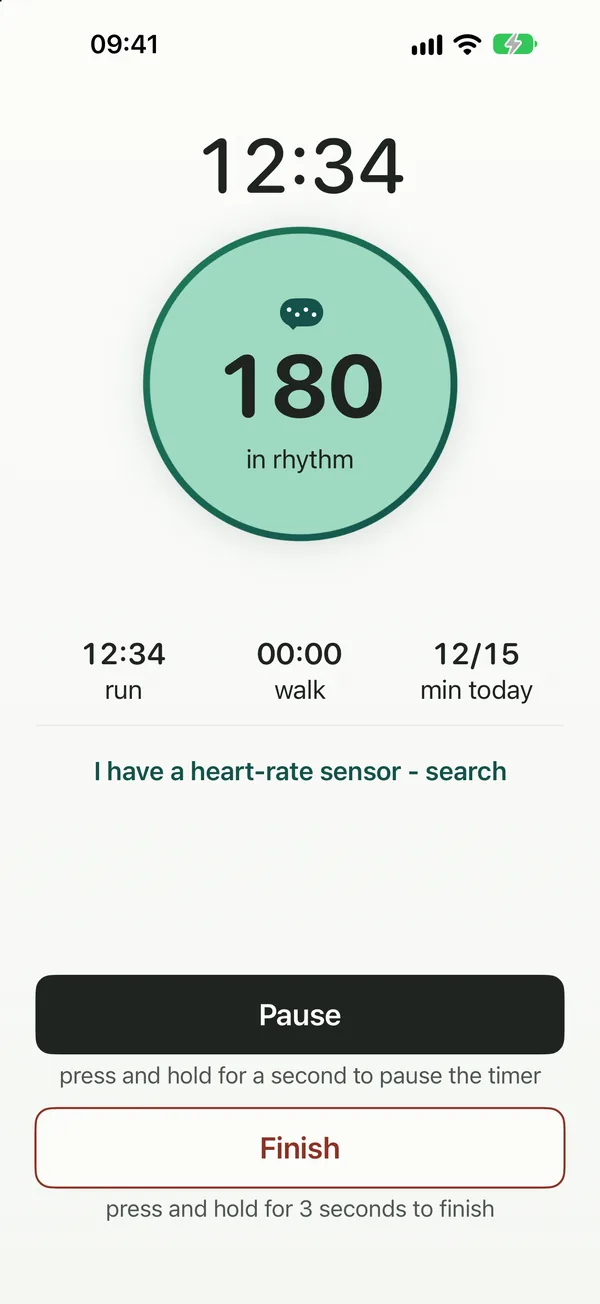
While you run
Your phone in your pocket is enough.
A 180 metronome
It beats at 180 steps per minute - on every step, or on every other step if you prefer. You can also run with no metronome: cues then come as vibrations.
Cadence from your pocket
Measured by your phone's motion sensor. No watch needed.
Running and walking apart
Walking is part of the method. Running time goes toward your daily goal.
Auto-pause
When your steps stop, the timer stops too.
On the Lock Screen
Time keeps counting with the screen locked, and your running time shows on the Lock Screen.
Readable on the run
Large text and dark mode.
Your progress
Minutes, not kilometres.
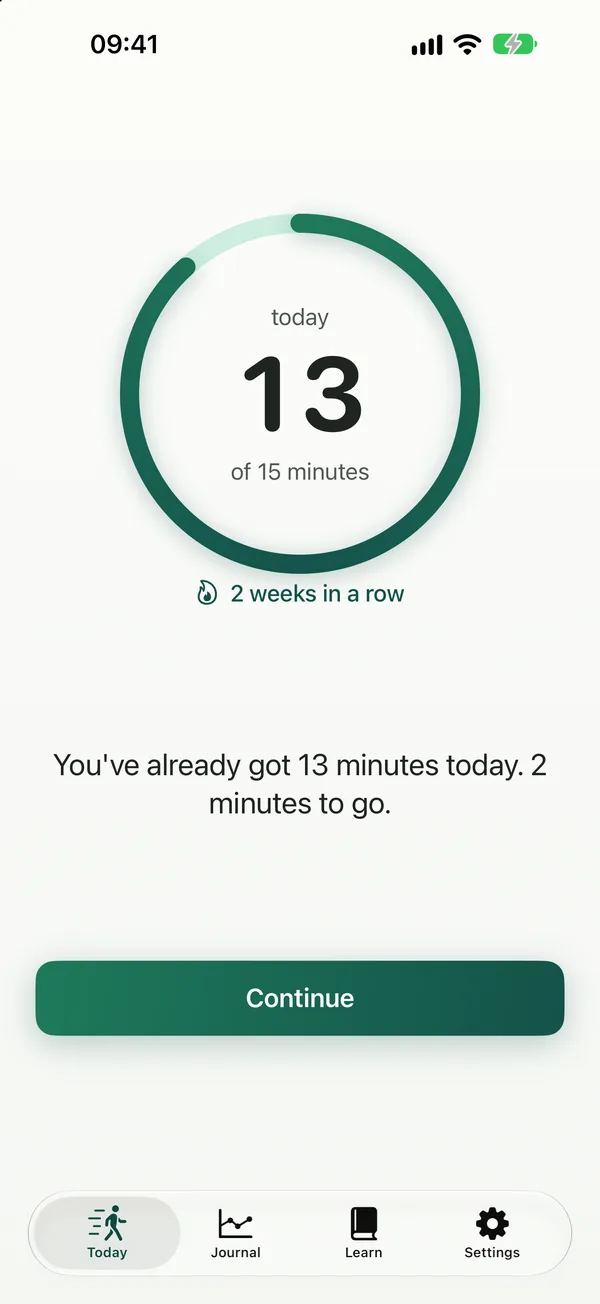
A daily goal in minutes
30 by default - collected from one run or several during the day.
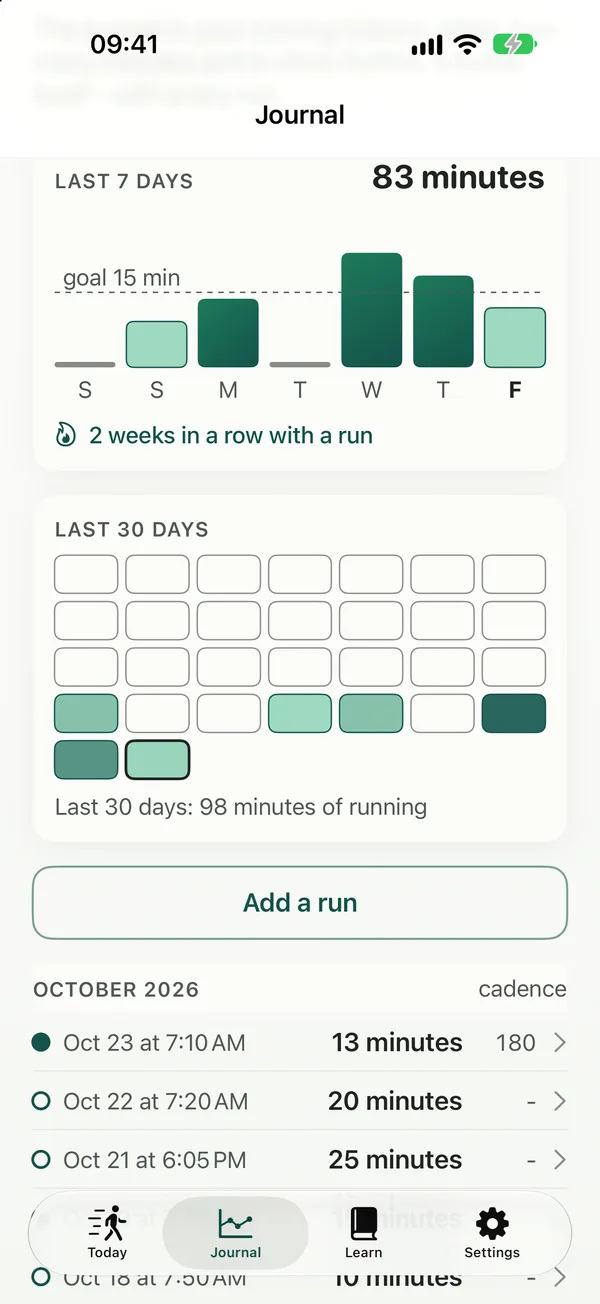
Week and streak
A weekly chart and a streak of weeks with a run. No penalty for a break.
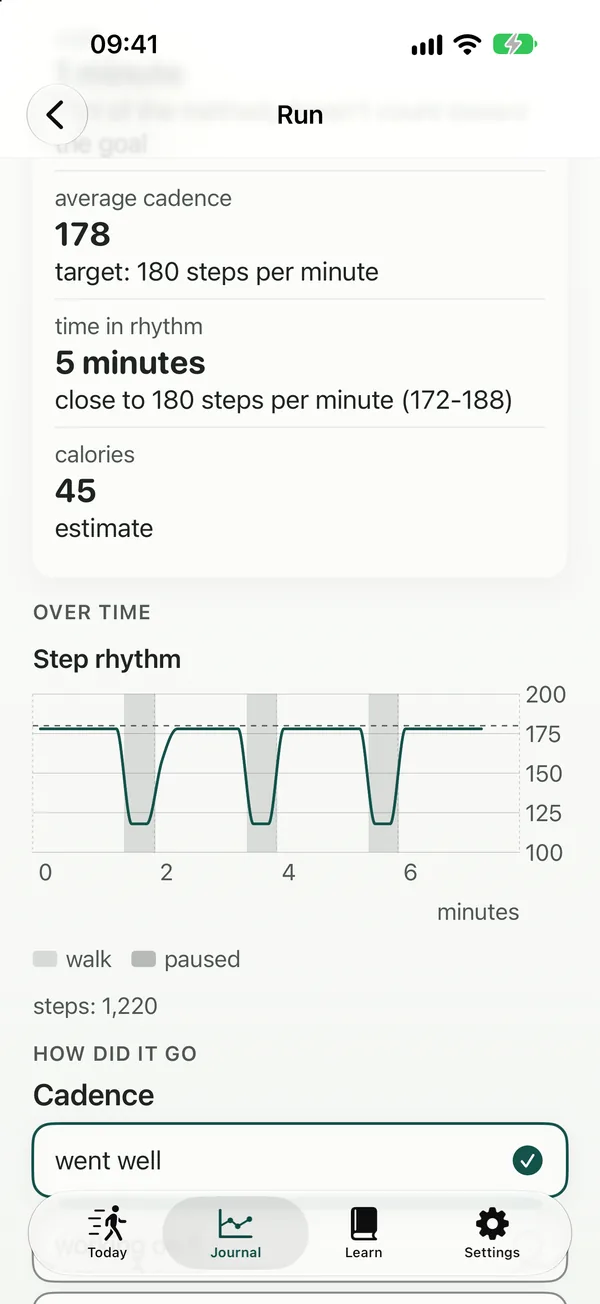
A journal with every run
Each run with its rhythm chart, GPS route (if you turn it on) and heart rate, if you have a sensor.
Add a run by hand
For example when you left your phone at home.
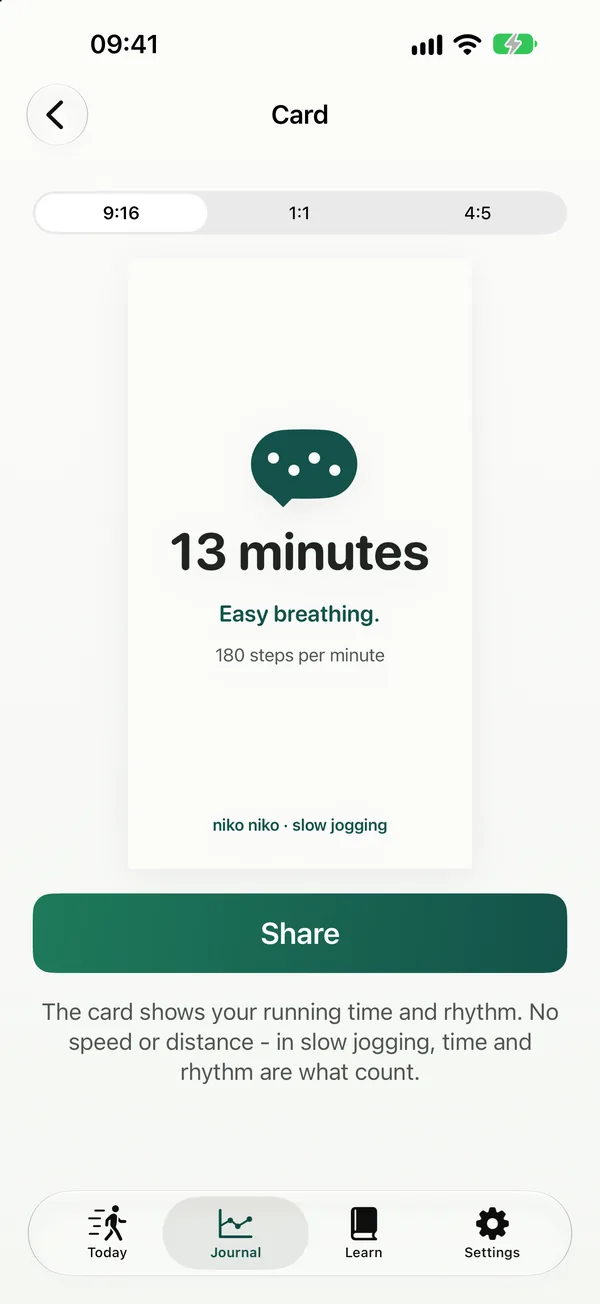
A card to share
Time and rhythm - no speed or distance.
Health, Siri, Learn
Save a workout to the Health app when you ask. "Start a run in Niko Niko". Short articles about the method.
Run at a pace where you can still chat.
In Japanese, "niko niko" means "with a smile".
The movement in the group photo was added by AI.
Premium
For free, you run in rhythm. With Premium, the app listens to how you run and guides you further.
A metronome that goes quiet
When you hold 180, the ticking fades on its own and comes back when you drift. Silence means: good.
Rhythm check
A tap or a word when your rhythm slips - no need to look at the screen.
Spoken coaching
A voice in your headphones: praise for a steady rhythm, encouragement, your daily goal, when to switch to walking.
Voice report
Every 5 or 10 minutes, a voice tells you your running minutes.
Heart rate and the niko niko guard
Heart rate from a chest strap, armband or watch. When it goes above your limit, you'll hear: switch to walking.
Technique focus
Before a run you pick one element of technique; afterwards you rate just that one.
Learn by listening
12 chapters introducing slow jogging, read in your language, in a male or female voice.
Export and AI analysis
Your whole history in one package, with a ready-made prompt. More below.
One-time purchaseno subscription · supports Family Sharing
Download on the App StoreNothing you get for free today will go away.
Extra Premium
Your runs, seen by AI.
The export is a package with your whole history: every run second by second, rhythm, heart rate and route. Give it to any AI assistant and ask about your progress - how many minutes, how your cadence is changing, whether your heart rate drops at a similar rhythm.
- Save the packageIn the Journal tab, at the bottom of the run list. CSV, JSON and GPX files with a description of the format.
- Give it to an assistantClaude, ChatGPT, Gemini, Grok - paste the prompt and attach the package.
- Talk about your runsObservations and gentle suggestions, in line with slow jogging.
You create the package and you decide where it goes. Once it is with an assistant, its rules apply, not ours.
See the starter prompt
Help me understand my running history from the Niko Niko app (slow jogging).
My data export is attached.

1. Read README.md first - it defines every file, column and unit. Don't guess
   units. If you can run code (Python/pandas), compute with code.
2. Use runs.csv for the overview. Open runs/*.json (second-by-second trace) only
   when you need the detail of a specific run.
3. Method context: slow jogging is running at "niko niko" pace - easy enough to
   talk; cadence around 180 steps per minute, short steps, landing on the midfoot.
   Walking is part of the method. Speed and distance are NOT goals - don't judge me
   by pace or kilometres. What matters: running minutes per day and week (the goal
   for each day is in runs.csv → daily_goal_min; if empty, in profile.json), consistency, cadence close to 180, time in rhythm
   (in_rhythm_min) and an easy heart rate (below my limit, if set). Cadence goes
   up with shorter, quicker steps - not by speeding up or slowing down.
4. Counting: weeks by start_local, starting on the day in profile.json →
   first_weekday (that's how the app counts; if the field is missing, Monday).
   Count from seconds (run_s),
   not from the one-decimal minutes: minutes of a day = ⌊sum of run_s that day / 60⌋
   - that's how the app counts. Check that totals add up (sum of weeks = total
   running minutes). Mention runs shorter than a minute (run_s < 60), but don't guess
   where they came from. The goal is DAILY: check it day by day (on how many days the
   day's minutes ≥ daily_goal_min); don't compare weekly totals with it;
   daily_goal_min = 0 means "no goal". A streak = consecutive weeks with at least one
   run (run_s > 0), counted back from the current week; an empty current week doesn't
   break it.
5. No GPS, heart-rate strap or trace is my choice, not an error - don't push me
   towards devices; just say what can't be assessed because of it.

Then:
A. Describe my way from the first run to the latest: number of runs, total running
   minutes, longest run, weekly minutes over time, streaks of weeks with running.
B. Show how cadence and time in rhythm changed; where heart rate exists - whether
   heart rate at similar cadence goes down (a sign of adaptation).
C. Give 3 concrete observations and 1-2 gentle suggestions for the coming weeks,
   consistent with slow jogging. No medical advice; if something looks concerning
   (e.g. unusually high heart rate), say so plainly and suggest seeing a doctor.
D. Name the data gaps: runs added by hand, without a trace, without cadence,
   without GPS. Don't invent anything.

Answer in my language, briefly, with tables where they help.
Your runs stay on your phone
We never see them. No server, no account, no sign-up. No ads, no analytics, no tracking. App privacy policy
Requirements
iPhone with iOS 17 or later. Heart-rate sensor optional, over Bluetooth. Available in 10 languages.
Get Niko Niko.
Free on the App Store. Questions: ask@slowjogging.net
This app is not medical advice. If you have a chronic condition, talk to your doctor about running.